Showing posts with label RingBoxing. Show all posts

Thursday, February 12, 2015

~Differences Between Bareknuckle Punching Opposed To Gloved Punching~

THERE ARE MILITARY PROFESSIONALS WHOM TRAIN IN COMBAT-SPORT METHODS OF BOXING WHILE BELIEVING THAT THEY WILL STRIKE THE SAME WAY BAREKNUCKLE AS ONE DOES WEARING GLOVES~


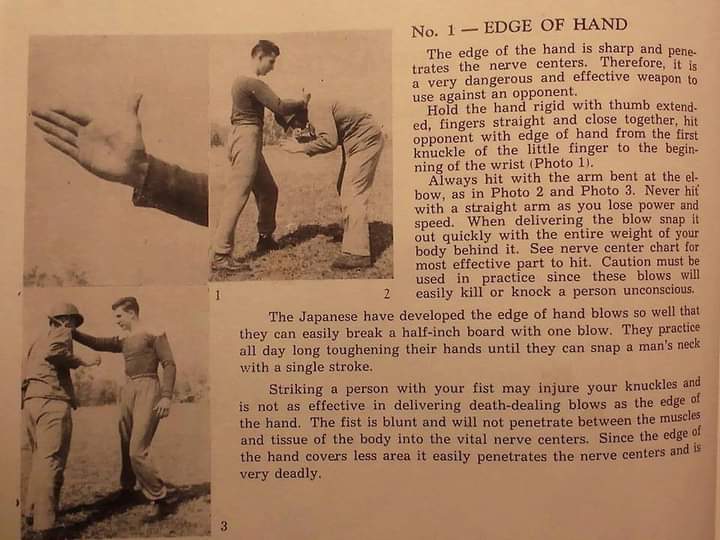
~During WWI and WWII many military hand-to-hand-combat instructors, like Captain Allan Corstorphin Smith, William Ewart Fairbairn, and Eric Sykes taught that the edge of hand/axe hand strike and palm strike/chin jab, prevalent in the Japanese Jujutsu schools, was a safer and superior method of striking with the empty hands in close combat. However there were other instructors whom taught 'bareknuckle' boxing methods to infantrymen during both world wars, along with grappling methods, as a viable option for close-combat.


~When we say 'bareknuckle' boxing methods, for the purpose of this article, that would include any method of empty hand combat that includes utilizing the hands for striking. Most specifically, that include using the fists for striking in close-combat whether it be English boxing, American rough and tumble, boxe française (also known as French Savate), Thai boxing, Chinese Ving Tsun boxing or the many other schools which utilize the bare knuckle fists as impact weapons.

~Today many military units, particularly western military units, have programs which incorporate various methods of boxing into their close-combat training. Some programs on bases out in the sand box train in western sport based boxing mixed with Brazilian Jiu-jutsu. Some train in Thai boxing mixed with grappling, while some units are even training in Gung-fu based methods.

~Of course the Marine Corp has their MCMAP and the Army has it's MACP while the Army Special Operations have SOCP. But down range some units are actively supplementing their training with individual unit programs which incorporate full contact sparring in sport-based boxing, Muay Thai, gungfu, or kick-boxing with some element of grappling often involved. The 82nd Airborne as well as other units often incorporate some form boxing along with grappling methods into their close-combat training and sparring sessions.

~Contact sparring along the lines of sport-based boxing methods like Western boxing, Thai boxing, American kick-boxing, Savate, or any other school of boxing is great for developing an aggressive spirit in a soldier or marine. In fact, if the goal is merely to foster fighting spirit and impact inoculation with no intention of ever engaging an enemy with lethal intent during a close quarter combat situation than carry-on. 

~ However, if this training is also meant to prepare the fighting man for the method by which he will engage and bring down his adversary in a close-combat situation than something must be said about the difference in how one must deliver a strike using the bare-knuckles as opposed to delivering a strike during sparring with hand protection, like gloves.

~There are some schools of thought which admonish the idea of using the bare-knuckles to strike the hard bony targets of the face and head during a frantic close-combat situation due to the risk of self-injury in the form of a boxer's fracture or busted knuckle. After all if the world heavy weight champion, Mike Tyson, can break his well trained hand in a 1988 street fight against fellow professional boxer Mitch 'Blood' Green than certainly anybody can suffer the same fate. And since professional soldiers are predominantly 'gun slingers' whom fight with weapons and operate sensitive equipment on the battle field, while performing sling-load operations, rappelling, fast-roping, mountaineering, swimming and airborne operations in the field, a badly damaged hand could hinder one's mission capabilities.

~However, there is another school of thought that propagates the use of bareknuckle punching in a close-combat defense situation. And it reflects in the amount of time devoted to their boxing, kickboxing, Thai boxing, etc...

~Ideally all military battles should be fought with weapons, but close-combat training is vital and necessary for when an adversary is able to close distance by surprise or deception before a weapon can be deployed and utilized to eliminate the threat. This has happened at check points while I.D. are being reviewed or when moving through crowds. Sometimes an ally at very close range can turn the tables and become an attacking enemy. Movements through fatal funnels are always potentially a close-combat situation. At any of these times the individual warfighter must fall back on their close-combat training.

~"Train how you will fight." This is a phrase every military personnel in a combat MOS or security MOS has heard and one which has a deep element of truth to it. However, sometimes for the risk of injury one must utilize safety equipment in their training. We utilize MILES gear, blank adapters, blanks, airsoft weapons, paint ball, aluminum knives and other safety gear in training. And yes, some include boxing or MMA gloves into their close combat training and sparring.

~So how does wearing boxing or MMA gloves hinder the development of proper punching technique for bareknuckle striking, in the context of military close-combat? Let's go back to training how we fight.

~When we wear hand protection we can throw punches 'to-whom-it-may-concern' while swinging for the fence. If you're American you will get the implication. In other words, we don't have to be so specific in target selection and are capable of putting our full power behind the punch with the added confidence of wearing hand protection. In addition we can pronate our punches aimed at targets located on the human head in the same way that we would pronate our punch when striking the targets of the torso. It seemingly makes a faster punch and with the protection of gloves we don't think twice about delivering the same pronated punch to the head as we do to the torso.

~The main reason for pronating the punch, or twisting the punch, so that it lands with the palm facing downward is that when we strike the targets of the torso our point of impact will be our first two knuckles. The index and middle finger knuckles are a smaller surface area attached to the two thickest metacarpal bones of the hand. This smaller surface area permits deeper penetration into the targets of the human torso such as the liver, solar-plexus, kidneys, and floating ribs. The key words here are deeper penetration.

~Now the problem is that in a bareknuckle situation it isn't prudent to punch the bony surface area of the face using the pronated two-knuckle punch that we use for the targets of the torso. We do not wish to penetrate the bony facial targets in the way that we wish to penetrate the softer torso targets.

~Generally speaking the bones of the face and head are thicker and harder than the delicate metacarpals and knuckles of the human hand. Again, professional heavy weight champion of the world Mike Tyson is a perfect example of why the modern sport-based boxing technique of pronating the punch to the face has it's disadvantages. In physics we learn that when two opposing forces meet the greater force will prevail. 

-Also, the same amount of force being delivered through an impact is also returned back to the object performing the impact. So the weaker of the two structures will be the one to give under the impact. If you could deliver 300psi (pounds-of force-per square inch) through a bareknuckle punch delivered to the face of another human being then the same amount of 'psi' impacting the bones of the face are also impacting the bones and knuckles of your hand. The 'psi' is shared when it is returns back into your hand, after impact upon the bone of the face.

~Let us also consider that, according to many scientific experiments, trained boxers hit with more 'psi' than martial art black belts. So when one uses that amount of force, which one develops through training with hand protection, and applies it to a bareknuckle close-combat situation where one's fists will be brought to bear against the hard bony facial targets we increase the amount of 'psi' being returned to the metacarpals and knuckles of the unprotected fist.

~Now let us examine the fact that a 'sport-based' boxer who trains and fights with gloves will also wrap and secure the wrists to prevent buckling and injury. When the punch is pronated the structural support in the forearm and wrist is weakened as opposed to when a punch is delivered straight, in a vertical manner. To counter the structural integrity issue common with the pronating, twisting, punch of combat-sports, Western ring boxers, Thai boxers, American kick boxers, Savate boxers will reinforce the wrists, as well as the hands.

~When we examine historical bareknuckle boxing methods like fisticuffs, Ving Tsun (Wing Chun), and Okinawan Toudi, among others, we will find that all punches delivered to the bony structure of the face were delivered with the back three knuckles with the fist in a vertical, or often diagonal, position. With this method the middle knuckle is the primary point of impact while the last two knuckles go along for the ride and support the middle knuckle. This method eliminates the common injury to modern fist fighters which is often referred to by orthopedic doctors as the boxer's fracture, dubbed so for being so prevalent among modern day boxers whom use the pronating (twisting) punch when striking head/facial targets. Especially when fighting bareknuckle.

~Old school bareknuckle boxers and Okinawan fighters understood that the pronating (horizontal) or twisting punch is of value when delivering the (penetrating) two-knuckle punch to the targets of the torso. The two knuckle, twisting, punch penetrates between ribs and digs deeper into the torso to damage soft organs. Particularly the liver and kidneys. But when delivering bareknuckle punches to the bony targets of the face/head they always used the vertical, or often diagonal, punch for the superior structural integrity of the fist and the wrist. Wing Chun/Ving Tsun boxers have always used the vertical and diagonal punch because they are a bareknuckle boxing school whose focus is on civilian-self-defense and they are not a competitive 'combat-sport'.

~A simple test one can try at home is to make a fist and place the first two knuckles against the wall, palm facing down, at torso level while applying one's body weight and pressure behind it, as if to push down the wall. This represents a horizontal or pronating punch. Rock the fist back and forth a bit. Now perform the same exercise with the fist at face level, above your shoulders. Notice how the wrist is weaker and the last two knuckles are floating on their own.

~Now perform the same test with the fist in a vertical or even diagonal position, with the thumb side up, and all of your weight and force resting upon the last three knuckles. You will notice that the fist and the wrist is more solid and secure in this position. This is the fist position which you will want to train and utilize when striking the targets above your adversary's clavicle or collar bone in a bareknuckle close-combat situation.

~Let us address perhaps the most important issue of all that separates bareknuckle boxing punches from gloved punches. The battle field is very different from the combat-sports arena. With the advent of wraps and gloves a combat-sport fighter can deliver much harder punches to the face/head targets without breaking the delicate metacarpal bones and knuckles in the fists. This makes for a more exciting fight for spectators since the boxers can throw more 'punches-in-bunches' toward the face/head in hopes of a spectacular knockout. It also makes modern combat-sports more lethal due to the amount of concussions received by ring/cage fighters. Without hand protection a bareknuckle punch must be held in check when striking the hard facial/head targets.

~When we strike the bony facial/head targets using bareknuckle punches we mustn't punch 'through' the target with all of our power nor throw 'punches-in-bunches' in the same way that we can with hand protection in the sporting arena. Nor in the way that we do when delivering bareknuckle punches into the softer targets of the torso.

~When executing bareknuckle punches to the bony targets of the face/head the rule of thumb passed down through the centuries is that one must 'snap' back the punch as soon as impact is made. The power comes from the quickness of the impact while the 'snapping' back upon impact allows the kinetic force and 'psi' to travel through the target without all of the force returning back into your fist. 

~Modern sport boxing and MMA coaches often teach to 'punch-through' the target. To try to drive one's fist through the adversaries face and out the back of their head. This is very effective in the ring or cage considering that the athlete is training and going into a bout wearing hand protection but here we are discussing 'bareknuckle' punching for a military close-combat situation since so many military units abroad and in the sand-box are currently training in various boxing methods for CQC/H2H.

~Old school soldiers and Marines going back to WWI and WWII whom received bareknuckle boxing instruction in their close-combat/hand-to-hand training were taught that the rule of thumb in bareknuckle punching in actual combat was:
A. When striking the torso, punch 'through' the target.
B. When striking the face/head, always 'snap-back' your punch upon impact.

~This seems to be lost knowledge among modern day fighters whom transition their combative skills from combat-sports into military close-combat/hand-to-hand/CQC training programs with the intention of being battle ready in a frantic life or death situation against a highly motivated, dedicated, enemy intent upon killing them so that he can earn a special place in paradise.

~If you are going to incorporate modern day western boxing/Thai boxing/MMA into your military combatives programs and individual unit training than it would behoove you to consider the necessary modifications which must be incorporated into your 'boxing' training. 

~Lets reiterate what we have discussed here in this article about the difference between bareknuckle striking and sport-based striking as it relates to 'punching' and the transition from combat-sports to the battlefield, or one's area of operation. Hoo-ah?

~1. The warfighter must use a vertical, or diagonal, punch when striking targets located above the clavicle (face/head) but may use a pronating/twisting punch, vertical, or diagonal punch when striking the targets of the torso below the clavicle.
~2. The warfighter must 'snap-back' his punches upon impact when striking the targets of the face/head but 'drive-through' the targets of the torso. Snapping-punches delivered to the face and digging-punches to the body.

~Let us make mention that in the realm of military combatives, unlike combat-sports, it is important to drill simulated strikes in training which would be illegal in combat-sports. Rabbit-punches using the radial bone to attack the back of the neck in close-combat is highly effective and dangerous, which is why it is illegal in combat-sports. 

--Everyone likes to discuss dirty tactics like eye gouging, biting, PPC, spitting in the eyes, fish hooking, striking the testicles, kicking the knees, striking the trachea, tearing off the soft tissue targets of the face and head, when they discuss the difference between combat-sports like MMA and CQC/Hand-to-Hand Combat. But there are many other attacks that are simple, efficient, and highly effective while being illegal to every combat-sport arena. 

-This is not meant to be an article for disseminating those specific attacks, which every warfighter should be training, but one need not look any further than studying every illegal attack banned from both catch-wrestling and boxing. Also study the attacks which ancient Greeks banned from their Olympic Pankra'tia matches, which were also the reasons why the Spartans were banned from competing in the same matches.

~If we wish to prepare for CQC/Combatives we need not look to modern innovations but rather examine that which was used with great success in the past. In more recent military history the greatest proving ground for effective methods of both training and employing combatives/CQC/hand-to-hand combat for the life and death struggles faced by the Infantryman or special operations commando would be both World Wars. No wars since have seen as much close-combat as WWI and WWII.

~Considering that the adversaries were Germans, trained in both western and eastern martial arts, and Imperial Japanese, trained in Asian martial arts, yet the American and allied troops were consistently able to prevail in close-combat engagements with the enemies at a much higher success rate is no small testament to the methods trained and employed by the military men of that era. 

-But everyone wishes to reinvent the wheel and some believe that the same techniques that achieve success in the sporting-ring will apply, unmodified, to the battle-field or area of operations. Let's also remark that combat-sports of that era still retained much of their practical self-defense/street credit compared to the evolution they've undergone with the advent of the post WWII commercialization of the competitive-martial/combat arts.

-As for the aforementioned Okinawan Ryu of pugilism let's give honorable mention to the most lethal empty hand (Kara te) school known to mankind. . .Uechi Ryu, aka Panghai-Noon, of Okinawa. 

-The legendary Shinjo Kiyohide sensei, aka Superman of Okinawa, is perhaps the most renown master of Uechi Ryu in my earthly life time. 

-Uechi Ryu is a tier one bare knuckle school of physical training, discipline and self defense which combines indigenous Okinawan Toudi with Chinese Panghai-noon dragon, tiger and crane boxing. 🐉 🐅 🐦 

~Si vis pacem para bellum...In omnia paratus.
12February2015, 
♣Hoo-ah♣

Thursday, October 16, 2014

WHY BOXER FRACTURES ARE MUCH MORE COMMON OUTSIDE THE RING.

*Thanks to the combat sports of western boxing, de-militarized martial arts for the purpose of sport or civilian self-defense, and Hollywood action movies most people across the globe today think of punching with the clenched fists, as percussion weapons, when they think of unarmed combat. So for the sake of this blog we will break down the science and mechanics of bare knuckle punching verses gloved punching in sport.


*Let us begin with the fact that the sport fighter when using punches most often has the protection of wrist support and wrapped hands to reinforce the structural integrity of the wrists, metacarpals, and knuckles. In addition to all of that, many modern ring fighters also don gloves.


*Contrary to popular misunderstanding the wraps and gloves are not meant to make the strikes less lethal to the recipient of the blows but rather to reinforce and protect the hands of the striker so that they can strike much more forcefully to the facial and head targets without breaking the wrists, metacarpals, or knuckles as would be very common injuries were they to engage in such action bare knuckle. Long ago they first began wrapping the wrists, hands, and knuckles in cord and sometime even covering the cord with a hard resin to allow the fists to be used as hard blunt force trauma weapons against the hard bony targets of the face and head in man to man combat matches. The reason the ancients did this across the earth was because they knew what every bone and joint doctor knows today, which is that the delicate metacarpals of the human hand and the knuckle joints are not meant to sustain massive impact trauma against the rounded and hard surfaces of the human skull.


*What about the Okinawan masters who conditioned the bones and strengthen the wrists and hands to absorb massive impact against very hard boards, brick, stone, and concrete block? And why did they train clenched fist strikes so extensively in the Okinawan schools of unarmed combat?


*First let us examine the fact that in many arts where the practitioners devote decades, if not a lifetime, to conditioning and strengthening their hands through what they call Hojo Undo training they are striking very hard flat surfaces with their bare knuckles when they perform breaking demonstrations to exhibit their achievements. With such intense strengthening and conditioning the bones through what science now calls Wolff's law the practitioner can strengthen the bones to sustain massive impact at the proper angles without breaking the metacarpals or wrists. However, let it be known that in these demonstrations one is striking a stationary, flat, surface with great attention focused to ensure that the middle knuckle, along with at least one other knuckle, impacts flat at the proper point of impact. Some schools will strike with the middle knuckle and the index knuckle as the point of impact at the weakest point of the board, brick, block, or flat stone. Other schools will strike with the middle knuckle and the back two riding along to reinforce the middle knuckle and metacarpal's structural support. But they do not ever punch bare knuckle to break a rounded and hard object, like a bowling ball, with a massive follow through punch because there is no way to evenly distribute the load of the impact upon the knuckles of the clenched fist. To take it even farther let us acknowledge that they would never attempt such a feat against a rapidly moving, rounded, hard, object using bare knuckles.


*In fact when we examine or train in an old style of Okinawan 'boxing' be it Toudi or Kara Te we will notice that the makiwara are almost always set at breast level height and never set at head level for bare knuckle punching. The makiwara is set at the level of the solar plexus or rib cage for conditioning and training hard bare knuckle strikes for a specific reason. The open hand or even hammer fist strikes are trained at the higher level makiwara, set above torso level, but the bare knuckle punches are not trained upon the makiwara above the torso level because the old masters understood the wisdom of using bare knuckle punches to the softer torso targets and bones of the chest cavity to inflict massive trauma or death, while utilizing other empty hand strikes to targets above the torso. They followed the rule of hard to soft and soft to hard.


*The close fist strikes were used in sparring or practice quite often in some schools to feign strikes above the torso in order to prevent serious accidental injuries. At the high levels where practitioners had developed more control they used the correct alternative strikes above the torso level during practice while reserving the bare knuckle punches to the torso targets, sometimes including the groin.


*With the advent of sport and de-militarized civilian self-defense methods (less than lethal methods) the bare knuckle punches were adopted for striking both below and above the torso to coincide with civil laws prohibiting deliberate killing another human being in a civil dispute. Teachers not wishing their students to kill or maim and receive a prison sentence or death penalty for murder under the law, nor wishing to be implicated for teaching or encouraging their students to use lethal methods were obliged to modify and demilitarize their methods by adopting the closed fist bare knuckle strikes for targets both below and above the neck.


*Never the less, with this de-militarized method being adopted by the Okinawan masters they also taught two methods of bare knuckle punching for striking. When striking the torso targets they taught to 'drive-through' the target and exert maximum force, as had always been the method used when striking the torso targets. But when bare knuckle punching the hard bony targets of the face and skull: chin, jaw, tempro-mandibular joint, nose, temple, etc, they taught to 'snap-back'. This snapping back combined with a pronation


*Let us examine bare knuckle boxing methods like Chinese Wing Tsun. The bare knuckle punches or the straight punches used to strike the bony facial targets, also being a less than lethal method taught for civil self-defense and safe practice, utilizes a punch that does not rely so much upon massive impact force to create a knock-out as in the harder punching methods of Okinawan, Thai, or Western boxing methods. But rather the Wing Tsun bare knuckle straight punches to the bony facial targets rely more upon the speed of overwhelming the opponent while using forward body momentum to keep the opponent on their heels and off balance until a take down can be achieved followed by a finishing blow of dropping the knees into the rib cage or the solar plexus while striking at the throat to finish the fight, or until the opponent surrenders in defeat. The Wing Tsun punches travel a very short distance and therefore do not generate the amount of force necessary to break the metacarpals of a conditioned fighter's hand.


*Western bare knuckle boxing or fisticuffs does not enjoy the protection of wrapped and reinforced wrists, metacarpals, and knuckles covered with gloves in an attempt to protect the wrists and hands from injury during a man-to-man combat match. Which in fact this practice of reinforcing the wrists and hands has made boxing combat sports much more lethal than the bare knuckle counter part because now the fighters can strike full force and need not be as surgical in their targets during a bout. Throwing "punches in bunches."


*With this new found power and confidence the boxer can afford to be a hard hitting head hunter and swing with all of his might at the bony skull/face of his opponent. A thing that would be foolish and most likely self destructive in a bare knuckle boxing match. And imprudent against multiple attackers in a potentially life or death struggle. Yet even with all of  this conditioning, reinforcement and protection for the sport boxers' hands their have been several incidences of professional fighters in boxing and other competitive martial arts venues whom have sustained broken hands. 


*Now when fighting outside of a ring or cage, many bone and joint specialists will attest, it is very common for fighters and practitioners of these modernized combat sports and competitive martial arts to sustain what is called in the medical community a 'boxer's fracture', a crushed knuckle, broken metacarpals, or broken wrist when applying the same methods of punching in the competitive venue to the proverbial 'street' fight. Even the American heavy weight champion of the world, Mike Tyson, was reported to having broken his hand in a street fight against a fellow professional boxer, Mitch Green, during a one-on-one fight that took place outside of a store. And we can't say it's because he doesn't know how to punch or that he was an untrained amateur, as many often claim when a fighter breaks his metacarpals, knuckles, or wrist in a bare knuckle fight.


  ♣WHAT THE OLD SCHOOL BARE KNUCKLE BOXERS KNEW ABOUT STRIKING♣


*When striking the bony facial targets with the bare knuckles always 'snap-back' upon impact. Don't try to punch through the target the way you can with taped, wrapped, and gloved hands.


*Bare knuckle punches above the torso should impact with the middle knuckle and the last two riding along to reinforce the second metacarpal and middle knuckle. Either strike with the fist in the vertical position (thumb up) or the fist in a diagonal position (a three quarter twisting punch but not the full twisting or reverse punch used in boxing and many martial arts). Do not impact with the first two knuckles and the palm down when bare knuckle punching above the torso to the bony facial targets. *The straight punch is ideal for the lead, jab, hand while the diagonal punch is ideal for the cross punch.


*When striking bare knuckle to the torso targets below the neck one may train to punch using any method of punching they prefer: horizontal, vertical, or diagonal, but the diagonal is still the most structurally sound punch. Preferred targets are the solar plexus, liver sack, kidneys, bladder, and testicles. The floating ribs (short ribs) are also targeted to cause injury and pain but seldom will cause a knock out in the way that the other targets can.


*Always 'punch-through' the softer torso targets as opposed to 'snapping-back' when punching the bony facial bones. This is always without exception the rule of thumb in bare knuckle striking and it is LAW. If any self-proclaimed guro, master, sensei, or expert teaches you to punch through the target when striking bare knuckle toward the bony structure of the face and head in a fight then you may consider them dubious or merely unexperienced outside of the competitive boxing/martial arts arena and they shouldn't be teaching 'bare knuckle' combat methods. They should stick to teaching what they know best, 'sport-based' combat methods.


*When throwing a 'hook' bare knuckle the method was to clench the fist in a way that the thumb rests upon the top of the index knuckle with the tip of the thumb nail barely protruding over the index fore knuckle. It was not a punch in the way it is thrown today in gloved boxing nor was it named because it is thrown in a 'hooking' motion. The 'hook' got it's name because the thumb, in the aforementioned position, would be slightly extended upon impact into the outside corner of the adversary's eye to 'hook' the eye! (This is bare knuckle boxing and it is dirty. Not 'sport' boxing.)


*The upper cut is not so much used in bare knuckle boxing though the shovel hook sometime is. If an uppercut is employed bare knuckle, one only used the heel of the palm much like a WWII 'chin-jab' uppercut under the chin at very close quarters or grappling range while slapping the lumbar of the adversary with the opposite hand. Sometimes a knee is brought up into the groin to cause the adversary to react by leaning forward at the same time the heel of the palm (carpal bone) is striking from under the chin to facilitate the knockout. Their head should snap backward, pinching at the brain stem, ideally resulting in a knockout.


*The round house punch is also delivered in bare knuckle boxing in a much different way, having the point of impact being predominantly upon the heel of the closed hand as the thumb is out of the way and resting atop of the index finger fore knuckle. The targets are the jaw, TMJ, ear, and steno-mastoid. As well as the temple.


                                                             ♣SUMMARY♣            
*I do not intend to make this a lesson in bare knuckle boxing according to the very old school methods before it became a sport, so I will not go any farther here. But in sticking with the subject at hand, we have laid out many of the common reasons why boxer-fractures and injuries to the hands and wrists are much more common outside of the ring when fighting 'bare knuckle' without the protection and reinforcement, despite professional training or years of conditioning.


* If one intends to train for the competitive ring then realize that one's methods and approach will be drastically different than if one intends to train for bare knuckle pugilistic applications outside of the ring, as for a self-defense situation. Not only will your method of striking, point of impact, and intention completely change but so will one's guard, defensive methods, and even footwork once the context has changed from inside the ring to outside of the ring.


*Let us also add that when the horizontal punch is used in bare knuckle boxing to strike above shoulder level the muscles in the forearm disengage and permit the wrist to buckle under massive force. And let us consider that the horizontal bare knuckle punch, as in a fully pronated punch used in competitive sport boxing and competitive martial arts, where the palm is facing down at the moment of impact, that should one slightly miss during the frantic bobbing and weaving of the adversary's head during real combat that the last two knuckles of the clenched fist (or quite often the last knuckle all by itself) will impact upon the hard bony structure of the adversary's face/skull with all of the massive kinetic force behind it which results in a boxer fracture. The same thing will happen if all of the force of a powerful bare knuckle hammer-fist impacts the little finger's knuckle upon the bony round structure of the face/skull.


*Again, striking a hard flat surface where the force is evenly distributed across two or more of the knuckles is drastically different than striking a hard rounded surface where the force of impact is more likely to be absorbed by a single knuckle when striking with both the horizontal (full twist reverse) punch or a hammer-fist when using bare knuckle punches in a frantic combat situation against a single adversary or multiples.


*This is why in bare knuckle boxing we 'snap-back' when striking bony surfaces but we 'punch through' when striking softer torso targets. And we never use the horizontal (palm down) punch when punching above the adversaries torso targets but rather train to employ vertical and diagonal punches to the targets above their torso (I/E: the bony facial targets) but may employ any type of bare knuckle punch we prefer to the softer torso targets below their clavicle.


*If you're trained in competitive sport boxing then you already have excellent body mechanics honed through training and all you need to do is now consider these reasons why boxer's fractures are much more common outside of the ring when throwing bare knuckle and incorporate these simple bare knuckle rules into your training so that your muscle memory will respond properly should you have the misfortune of having to resort to bare knuckle boxing for a self-defense situation.


*Remember, self-defense is all about self preservation so it makes no sense to destroy the tools which you must rely upon throughout your survival in daily life. And our hands are some of our most important tools. So if you are foolish enough to be caught unarmed and then decide to 'punch' your way out of danger with bare knuckles than at the very least learn the difference between punching in a competitive sporting arena and bare knuckle punching in a close combat defense situation.


16October2014
AnDrew Soldier


P.S.
  The author of this blog does not contend that bare knuckle boxing
is a preferred or even prudent form of empty hand self-defense in
a potential life or death struggle against single or multiple attackers.
  And if the situation is not potentially life or death then one could
argue that there is no need to engage in such aggressive negotiations.
  And finally if one feels the need to aggressively resist a potential
life or death situation than the author contends that a more dedicated method
than one's bare knuckles may be justified and more prudent.
  Never the less, all empty hand methods of practical close quarter combat
have their benefit as a method of last resort until one can escape or create
space and access a better 'tool'.
The author believes that boxing's greatest asset to the realm of unarmed combat defense is in it's outstanding evasive maneuvers, trapping and tying up the attackers limbs and in safely acquiring the clench without getting knocked out in order to utilize standing grappling techniques from Kodokan Judo, Jiujitsu or Catch Wrestling.  
♣Hoo-ah♣

Monday, June 16, 2014

Quick Thoughts About Bare Knuckle Fisticuff Boxing VS. Gloved 'Ring' Boxing Methods.

   In the heyday of John L. Sullivan and bare-knuckle boxing matches in the 19th century, fighters mostly threw snapping punches to the face and hard punches to the body until an opponent was an easy target for a knockout, which is why they adopted a fighting stance that can look a bit comical to spectators of modern boxing. 
   It was a 'science' not the violent brawling we often see today between two men whom engage in fist fighting. And it was a less than lethal alternative to dueling, which had previously been the preferred method of settling disputes between men for centuries. 
   Rather than two men settling a dispute with swords, knives, or pistols the fisticuffs (bare knuckle boxing) became a much preferable method of settling a dispute. In the lethal dual one man (perhaps even both) may go to his grave while the survivor may face the hang man's noose, depending upon the laws of the land at the time. And the survivor at the very least would have to worry about the avenging family members of the man whose life he took.
   The more civilized answer to all of this was to settle things in a challenge of fisticuffs, man to man, until one man surrendered or could not continue the fight. This was not necessarily meant as a form of close combat defense in a life threatening situation or a battle field combat art, but rather it was more of a method of 'social fighting' albeit could result in very brutal injuries to the participants.
   Being a method of 'social fighting' and a less than lethal option for settling disputes among men, it was exercised man to man, or one-on-one if you will. There was originally kicks, head butts and some grappling involved, in addition to the various hand strikes and punches. However it was the gentlemen class of society whom modified it to 'keep it clean', if for no other reason than to avoid maiming injuries which were common in the more brutal form. So the mutual parties would agree to no biting, eye gouging, groin shots, or head butting. And eventually they would agree to no clenches and grappling if one challenger was at a physical disadvantage of weight and brute strength. That way among 'gentlemen' it would be kept to 'clean boxing' with their seconds witnessing the duel and ensuring that both parties gave a fair play. 
   By it's very nature, it's origins as a less than lethal form of duel between consenting plaintiffs, it being very much a form of 'social fighting', fisticuffs (later to become boxing) was never really meant as a battlefield method of kill or be killed hand to hand combat. It was meant for one-on-one dueling with the empty hands whereas both men could take their time and feel out their opponent, weakening their opponent with precision strikes, chipping away until they could find a chink in their armor and then finish with a knockout blow. Very effective 'science' for the realm of social violence indeed.
   However, for facing 'asocial' violence where one's very life is on the line, probably facing edged weapons, and most certainly multiple attackers the fisticuff boxer didn't have the time to chip away at each and every attacker with snapping blows until they were weakened or dazed enough that one could deliver a knockout blow. Particularly when multiple attackers: be they highway robbers, thugs, kidnappers, or bugger men prefer to tackle their victim to the ground in a mass attack. Anyone whose been in a mass attack or even engaged in a simple game of American tackle football or Rugby knows a single man fares a rough chance in remaining on his feet should a small group of strong men wish to take him to the ground. And anyone whose ever witnessed a bare knuckle fight between a boxer and a single wrestler knows that it's very difficult for the boxer to remain standing if he doesn't score a very fortunate knockout before the grappler gets in clinch range. Multiply that by three or more and even a blind man can see the limitations in the social fighting science of fisticuffs or boxing within an 'asocial' situation. 
   Never the less, the bare knuckle fisticuffs boxing method was very effective given it's purpose and design. Long after the advent of the Marquis of Queensberry Rules boxing became more of a spectator event rather than solely a method of settling a dispute between two men. This brought in the gambling, the fight promoters, scheduled rounds, and eventually the hand protection with gloves.
   My understanding is that the use of boxing gloves was introduced precisely to enable fighters to punch one another with full abandon: promoters liked that it made the fights more exciting and never mind the harm done to the fighters along the way. This is part of why the incidence of serious brain trauma among boxers may have increased after the introduction of gloves.
   This is also why modern day boxers often break their hands when they try to transfer their sport (gloved) boxing style to the streets in bare knuckle combat.
   For one they're still 'swinging for the ropes' as they're accustomed to doing with taped, wrapped, and gloved hands.
   Secondly, they pronate until their hands are all the way horizontal as they're use to doing in gloved boxing which can often result in what doctors call a 'boxer's fracture'.
   Bare knuckle boxing styles like old school Fisticuffs, Wing Tsun, Kunfa, Jeet kun do, and several others propagate the straight punch or the forty five degree angle (three quarter twist) punch to prevent breaking the conditioned bones and knuckles in the hands when striking above shoulder level during bare knuckle fisticuffs.
   Sport boxing is great for training the body but to be applicable for bare knuckle combat it must be modified and trained differently. The fighter's guard, surface area of the fist, and even the intent must all be adapted for bare knuckle boxing.

   With gloves the boxer can be more of a head hunter in his strikes as well as fully pronate his punches and hit full power with most any part of his fist. While the old bare knuckle boxers relied more on discombobulating their opponent with sharp snapping strikes to the facial targets followed by powerful knockout blows to the torso targets: liver, solar plexus, floating ribs, kidneys, and the sternum.
   All of this being said, let us consider the nature and purpose of which such boxing methods of 'social' combat were designed to serve when we consider our own reasons and purpose for training in the unarmed combat methods.
   All methods are like 'tools' and as with tools they are designed for a specific purpose. We can sometimes successfully drive a nail with a large wrench but this does not make that's it's proper purpose and design. And if we were to acquire the proper tool we'd be more appropriately prepared to drive that nail.
   In combat: depending upon the terrain, social or asocial setting, threat, intent and many other factors, we must be prepared with the proper method for dealing with each situation prudently. 
   "Failure to properly prepare means preparing to fail." In the Army we have a saying, 'Train how you fight'. This doesn't mean to actually attempt to maim and kill your partner in training. But it means to train properly for that situation...In other words, don't train sport boxing methods if you're preparing for bare knuckle 'social' violence. Likewise don't train bare-knuckle if you aspire to fight in the sporting ring with gloves. 
   And finally, don't merely train in 'social' violence methods/sciences if your desire is to prepare for surviving 'asocial' violence.  
  
   ♣Hoo-ah4Life♣
AnDrew Soldier.


Sunday, April 13, 2014

'A Brief Discourse On The Historical Evolution of Close Quarter Combat'

   Personal experiences growing up in a lot of violence and being very small for my age taught me that my training in the martial arts was not preparing me well for unorthodox, bigger, stronger, and violent multiple attackers.
   So I began examining natures most fierce and lethal animals to see what makes them combat effective. A wolverine is only 3ft long and 35lbs max but is feared by the mighty Grizzly bear and is known to take fresh kills from a pack of timber wolves, each weighing over 200lbs. I discovered the most effective and ferocious creatures, aside from the venomous, almost always go after the throat, eyes, testes, or utilize constriction methods around the neck. Also I noticed that some will attack the legs to bring down adversaries yet always finish with an attack to the throat.
   Nature's most vicious creatures very often utilize a primary attack to their prey's structure that culminates into a secondary attack to the airway or the cardiovascular system. Combining this wisdom with redirection, trapping, unbalancing techniques, structural attacks, evasive footwork and fluid hand movements created for me simpler and more efficient method which later brought me notoriety both among peers and later within my military unit.
   The knuckle brawling, kick boxing, and closed hand punches above torso are not ideal - as many well know - in real world combat situations. A lot of great martial arts I've both researched and trained in have excellent 'defensive' techniques against strikes, yet they drop the ball when they utilize counter-attacks.      
   They quite often counter attack using closed hand punches, sport-boxing styled strikes, or execute effective take downs followed by an attempt to beat out a grounded adversary with bare knuckle fists, MMA style ground & pound. Or they may teach a single finishing punch as if that will always end a determined attacker: I/E, a punch to the nose, jaw, or temple.
   Well, if they had engaged in very many violent street, or prison, altercations experience would have taught them better. Most martial arts in their oldest form knew this but over time they became De-militarized due to civil laws which forced the masters to modify them for civilian self defense so everything lethal became a less than lethal, or more sporting, closed hand punch to targets above the torso.
   Some traditional martial arts (T.M.A.) masters today still do not know this and believe they are practicing the 'original' combat art.
   For instance, the original Wing Tsun's boxing method would not use close fist punches to the face but open hand finger jabs to eyes often followed by heel palm, open ridge hand, knife hand, or forearm and wrist strikes to the trachea and neck nerve plexus as the head retreated back from the eye jabs.
   In it's original application this was a very lethal boxing art for close quarter combat. First created by a female, it had to be efficient and could not rely upon powerful fist strikes to the hard bony facial targets considering the metacarpal bones in a woman's hand are even more delicate than a man's.
   The hands were later closed during sparring for safety among beginning students. The masters often held the key to the actual striking methods for combat until students proved themselves both loyal and honorable after sometimes years of training. In later times masters only taught the actual combat applications to their most loyal protégé. This is why students whom trained with their masters a very short time before going off to start their own schools, particularly in the Asian schools of combat, much like Jun Fan 'Bruce' Lee, often unknowingly had never received the keys to their master's science. And thus generations after who trained under particularly gifted athletes whom had trained a relatively short time within a combat science school learned a bastardized method which continues to propagate itself with each generation. Not to mention with the advent of Hollywood action movies which have greatly done more harm in misrepresenting actual martial science in the minds of viewers than good.
   Once again the idea of Wing Tsun's finishing techniques, for instance, was to either stomp a downed attacker in the floating rib, liver, throat, nape of neck, or to drop both knees into their ribs or solar plexus and deliver a punch or chop into their throat during a time when lethality was legally more acceptable in self-defense across most of Asia.
   With the more feudal times giving way to increased civil laws, in order to survive many masters modified the original methods and intent of their combat science to create a more legally acceptable 'civil' self-defense. While others almost completely forsook the original intentions and methods, thereby modifying their science into a combat 'sport' or an historical art-form to preserve some similitude of their history's more feudal times. Still in some places under colonial rule combative sciences had to go completely underground or were hidden within innocuous dances.   
   The original Western Fisticuffs, bare hand boxing, in the western countries didn't use bare knuckle strikes to facial targets. In it's origins it applied fists to the torso targets and cuffs (open hands) to the facial targets, as well as finger jabs. The primary targets were cuffs to the ear drums, heal-palm strikes to chin, tempro-mandibular joint or bridge of nose, edge of hand 'chops' to the neck nerve plexus and finger jabs to eyes.
   As one's adversary reflexively reacted to such strikes this opened up the torso targets for a knockout, fight ending, shot. Traditionally that is a conditioned fist strike to the Solar Plexus, liver, kidney, spleen, floating ribs, or testicles.
   They also would open hand cuff the steno mastoid with heel palm, radial bone, or ulna bone strikes to facilitate a knockout. Sometimes using open hand or wrist chops to the back of the neck we'd call rabbit punches, which are considered lethal strikes.
   This was a very effective & lethal form of boxing with minimum risk to one's hands. Later for gentlemanly 'sport' fights they modified it to all closed hand strikes, both above and below shoulders. This made it less lethal and more bloody for the spectators, while allowing the fights to continue longer for entertainment. Unfortunately many fighters, particularly in the Americas, retired with terribly injured hands preventing them from engaging in a trade or working in the industrial revolution.
   Okinawan Toudi, in similar fashion, originally used no fist strikes to facial targets either but later was demilitarized by the Japanese for athletics, sport, and civil self-defense. Some of the Okinawan masters today teach two methods for fist striking to the facial targets to somewhat reduce risk of serious injury to the metacarpals in the conditioned hands of the karateka. They teach a four quarter twist punch, palm facing down, to beginners for both torso and facial punches in order to prevent serious injuries in training and sparring. While they teach the seasoned black belt level students the more combat effective and structurally sound three quarter twist punch. The first person to bring this pearl of pugilistic wisdom to my attention was Coach Daniel Sambrano, whom in my humble opinion is one of the world's most knowledgeable masters of bare-knuckle combat striking.
   When we examine many of the closed hand techniques still practiced in Asian arts like Kali and Silat we find that they were meant to be used with a short hard wood weapon, a knuckle duster, or a small Ker ambit blade, and not the bare knuckles as we see in beginner level training and public demonstrations. Some instructors still teach that the closed fist punches meant to be used with a hand weapon can be used in unarmed combat utilizing the same Kali or Silat methods.
   Well, any bone doctor will tell you that the little finger knuckle used as point of impact in a hammer fist strike is the most delicate bone in the human hand.
   The hammer-fist strikes mimicked in some Japanese Jujutsu schools' curriculum were originally used with the hard wood yawara stick.  Many practitioners don't know this today as they practice closed hand punches to facial targets in their templates or sequences. 
   Does years of training in a traditional martial arts school or commercial sport based martial art adequately prepare anyone for the dynamics of real world close quarter combat while giving them a huge advantage over individuals whom have never earned the Asian black belt and have never competed in an organized combat sporting match?
   Many of the most dangerous killers in prison have no training but rely upon the power of intention while utilizing the weapons of speed, surprise, and violence of action (as taught in the armed forces' infantry) to overwhelm their intended victims. They don't rely upon training but rather experience from a history of violence.
   Often criminal gangs will utilize superior numbers as well to insure victory. The U.S. Marines teach the rule of no less than three to one and many civilians utilize this very unsporting concept to enact violence upon others in a similar fashion. So a survivor must consider all of this in any altercation that cant be avoided or escaped. Traditional martial arts and sports based commercialized martial arts do not address this adequately in their training. When we do see them teach some form of combat science against multiple attackers quite often even at the highest levels we see a well choreographed sequence of multiple attackers engaging one at a time rather than all at once as they would do in a real world combat situation. And they attack either in a very traditional martial art manner or in contrast attack in a very unlikely manner.
   Real world attackers often attack in multiples, using very unorthodox strikes, very aggressive and dynamic holds, and are never fixed still during an attack awaiting their victim to counter their hold or engage them all one at a time. That is fantasy bravado being sold as self-defense.
   Sport based striking methods we often see do not always neutralize an aggressor as rapidly as would be necessary in a multiple attacker or edged weapon attack situation. This can be witnessed in the ubiquitous MMA and UFC matches where two very hard hitting men with the aid of taped, wrapped, and gloved hands smash each other in the face, head, and body for what can sometime seem like an eternity before either quits or a referee stops the fight. We sometimes witness the one punch knockout by some of the more gifted fighters like Anderson Silva and Chuck Lidell but this happens less often than the full scale brawl. And throw in multiple attackers in a street situation, no hand protection, and each man has a different tolerance to physical trauma, maybe they are hyped up on drugs, and that is where things get dangerous and sport based fist fighting becomes less optimistic.
   Once attacked it's always a kill or be killed mentality. Every stabbing I have witnessed either 'personally' or on a security camera the victim didn't know he was being stabbed but rather thought that he was being punched, until he saw his own blood or just collapsed. And I almost never saw the knife until after the attacker was finished stabbing his victim.
   During one incident I stood a few feet away while a group of criminal gang members stood security while their gang brother attacked a smaller man with a knife. The attacker wore thick work gloves with a knife tied to his right hand and he attacked like a sport boxer using the left fist as a jab and his right hand (power hand) to stab with. His victim the entire time while trying to cover up kept calling out, "Why are you hitting me Billy." After the attack was over and the gang members dispersed the man left dying on the ground while men walked over his body had never known he was being stabbed to death but had thought he was in a fist fight. Sitting here writing this today I only remember that man by his nickname, 'Guitar-man', because he was a gifted guitarist. He is only one of several I've seen stabbed to death. And like him most thought they were in a common fist fight. "The greatest danger of a blade lies not in the sharpness of it's edge but rather it's concealment."
   That is 'reality', and not the dojo scenario of the static one armed knife attack. In fourteen years experience within the C.C.A. private prison system I have witnessed more stabbings, killings, swarm attacks, and rapes than I care to recall while getting a good education in sophisticated criminal ambush tactics.
   It's an art that these criminal gangs practice in killing and kidnapping. Too make matters worse some unfortunately have military background with combat experience and more than a few I have witnessed having MMA training.
   Criminal gangs are getting more sophisticated yet many instructors teach that thugs and criminals are unskilled cowards. In fact if we study U.S. history we will see that during the age of prohibition many of the gangsters and bank robbers were in fact military trained and often combat veterans who used their training and experience for criminal activities and left the police force completely outmatched and outgunned. This later led the F.B.I. to evolve from strictly a kidnapping investigative branch to a more paramilitary federal law enforcement agency.
   When we look at the history of Shanghai we see that there were criminal gangs of armed and martial arts trained gangsters and thugs infesting the city. Municipal police were outmatched so they had to evolve in methods and combat skills to counter these vicious criminals. This era gave birth to such legends as Eric A. Sykes and William E. Fairbairn whom were later called upon to train Allied Forces during WWII in close quarter combat methods which had proven effective in countless close combat situations against armed and traditional martial arts trained gangsters on the vicious streets of Shanghai China.
   So the point here is to show that historically not all criminals are a bunch of bungling idiots who have no combat skills as I've heard many martial artists often say.
   The dojo clowns who teach that criminals in the street are untrained and unskilled haven't had much contact with criminals these days...I've seen triangle chokes and anaconda chokes used in prison by gang members and thugs. The rear figure-four choke is a favorite! And they use it quite often in the streets to rob and assault the unwary.
   They condition their knuckles, as in Okinawan Hojo Undo training, while lifting heavy weights or doing military style body weight training all day long. They study Grey's anatomy books, practice MMA take downs with submissions, train on the heavy bag, run around the ball field, do thousands of side straddle hops to build cardio, learn numerous ways to fabricate weapons and study to be deceptive tacticians. I've seen knives made from paper that are hard as steel  and will penetrate a torso or neck with ease. On the streets some criminal organizations have instructors whom train other members in close quarter combat, martial arts, weapons, tactics, and even law so that they can utilize legal loop holes to get reduced sentences or plea bargains should they ever be caught.
   Too many martial artists are walking around poorly prepared for a life or death situation while engaging in ego masturbation which leads to an inflated sense of ones own abilities and an underestimated view of one's enemies.
   To those that say that unprovoked violent attacks will rarely ever happen, I've been unfortunate enough in my personal life to have faced such situations more often than I'd like to recall...So for some people, it rarely happens but for others it can become a perpetual cycle.
   It depends upon where you live, economic status, and where you work or find yourself having to travel. Also one's physical appearance, build, racial appearance, and how attractive one appears to others can attract unsolicited predators in the most unlikely time and place.
   A man or woman never knows what the future holds for them, even if they're law abiding citizens, so it's best to train for worst case scenarios and not need it than to train for mild scenarios and then suddenly finding oneself in a nightmare. Because before you can process what is happening to you it's over and you've been traumatized, or you're dead.
  Martial arts and any form of close combat training are meant to be insurance policies in case of violent confrontation or a worse case scenario. And unarmed methods are meant to be developed through training and pressure testing as a last ditch effort in the advent that one is caught unarmed or has lost their weapon. They are not meant to be just an athletic activity, a sport, spiritual path to nirvana, or a flowery dance to impress onlookers.
   If real-world combat experience is the greatest teacher, as opposed to classroom theory, sparring, and regulated 'sporting' matches, then how can so many peddle their flowery, overcomplicated, impractical 'Life Insurance' to naïve students without ever having actually experienced and tested what they claim will stop or neutralize an attacker, disarm an intently armed attacker, or is the best method for defending against multiple attackers in an unarmed situation?
   Not to propagate any one art over another since one can find good things in every art, though sometimes we must cannibalize the art to extract what is practical and useful under the duress of combat and what is efficient against single or multiple attackers, but when we compare what is being today taught in so many commercialized martial arts with what was taught and trained one hundred to five hundred years ago we will see a drastic difference.
   What was once extremely simple and practical, but quite vicious, has evolved into something overcomplicated, often impractical, and less efficient under the duress of adrenaline fueled combat against violent attackers.
   Originally all martial arts were weapon's based and the unarmed hand to hand techniques were meant as a last ditch effort should one's weapons be dropped or one be attacked before drawing one's weapon. Some grappling techniques were trained for subduing prisoners or effecting arrest while other grappling with a handful of striking techniques were meant to cripple or kill an attacker on the battle field.
   If one considers pre-Edo period Japanese Jujitsu the grappling techniques were designed to disarm and take down or immobilize an opponent on the field of battle so one could draw a short sword or dagger to finish them off by piercing between the folds of their battle armor.
   After the Edo period samurai later began performing more as law enforcement officers against unarmored civilians so more strikes using the hand held yawara stick or even the empty hands were incorporated into Jujitsu or Taijutsu methods of application. Closed fist strikes were utilized against the atemi torso targets while open hand strikes were delivered to the Atemi targets above the torso area. A samurai relied upon his hands to master his weapons: Katana, wakazashi, tanto, spear, and archery bow, as the primary tools of his trade and he could not jeopardize the integrity of his hands which he needed for his livelihood, much like a professional soldier today.
   When we look at ancient Greek Spartan Pankratia as the hand to hand combat system of the professional Greek Spartan soldiers history tells us they were actually forbidden from competing in the ancient Olympic games in Pankratia competitions because they were conditioned to fight for real combat and not sport. They approached hand to hand with the intent of snapping a leg with a knee or ankle lock, taking out an eye, seizing and crushing the trachea, rupturing the ear drums, using lethal neck cranks/neck locks, and lethal chokes. They killed or permanently maimed and crippled their opponents because they never trained under sport applications but rather actual (efficient) combat applications, so they were banned from competing in ancient Olympic Pankratia matches.
   They didn't fist brawl or even use conventional competitive wrestling techniques for their hand to hand combat methods because their intent was to kill or cripple an opponent in battle should they need to silence a sentry during a commando raid, were ever caught foolishly unaware, or disarmed in battle.
   They didn't train to punch their opponents to death with fists as that would be too time consuming against a battle hardened enemy soldier and too self destructive to one's hands when their survival relied upon how well one could wield a Spartan spear, sword, and shield.
   More recently let us look at WWI and WWII to examine world wars where hand to hand combat was most prevalent in the trenches, house to house fighting, and the dense jungles. Both American and allied soldiers and marines met fierce hand to hand combat against traditional European and formal Asian martial arts with the intent to kill or be killed. Can one imagine a more fierce proving ground for the martial arts than both World Wars?
   The method which proved to be most effective was not exactly a traditional European or Asian martial art. It was a simple, efficient, and brutal approach developed by martial arts experts and venerated combat veterans of the brutal streets of Shanghai China. The city of Shanghai at that time was the most violent city and murder capital in the world. Criminal gangs ran the city and freely controlled the streets with brute force and terrorism.
   One of the men who served as a street law enforcement officer in Shanghai at the time was a British fellow named William Fairbairn. He studied and earned ranks in western martial arts such as boxing and wrestling as well as various Asian martial arts such as Chinese Kempo, Jujutsu, Judo, and even had trained under a famed Imperial body guard. Despite all of his training and the side arm he carried Fairbairn was almost murdered when he was clubbed and knifed by multiple attackers during one of his patrols. In other instances many of his fellow officers were not so fortunate.
   After such experiences William Fairbairn re-evaluated everything he had trained in contrast to his vast personal experiences with life and death close-quarter-combat while enforcing law and order on the world's most violent streets, outnumbered, against gangsters who were trained in traditional Asian martial arts and armed with weapons. He came up with an approach for close combat which utilized simplicity, the most efficient tools of the human body, targeting the most vulnerable anatomical targets, and using natural body movements which could be executed under the duress of intense life or death hand-to- hand combat. But most of all he stressed the importance of 'vicious intent' and directing that intention toward one's attacker or enemy. I believe it was Bruce Lee the actor and martial artist who said he feared not the judo, kara te, or gung fu man but the untrained man who would not quite until you killed him.
  So Fairbairn's approach to close quarter combat was battle tested and more often than not proven superior against classically trained and armed street fighting veterans of the Shanghai criminal syndicates. He simply called his method of close quarter combat 'Gutterfighting'.
   After the outbreak of war the Allied forces saw a real need for close quarter combat training for soldiers and marines. The enemies had proven to be formidable adversaries when confronted in close quarters due to their classical martial arts training. Allied forces had relied upon miscellaneous military men whom had trained in western or Asian martial arts to share their knowledge with troops within their respective units and that had to suffice at first. But later William Fairbairn and his comrade from the Shanghai police, Eric Sykes, were called to share their vast close combat experience and methods with Allied forces.
   Allied military leaders discovered that official investigations of many documented reports of close quarter combat engagements on the battlefield showed that the personnel whom had trained in Fairbairn's simple, efficient, and vicious method of 'Gutter-fighting' consistently achieved more success and close quarter combat kills than personnel classically trained in European or Asian martial arts. This was no small feat since particularly the Japanese were skilled in judo, jujitsu, and kara te while the Germans trained in European wrestling, boxing, and Japanese jujitsu.
   William Fairbairn taught British, French, and American personnel that only a fool resorts to unarmed Gutter-fighting and one should never be caught without a weapon, be it a rifle, pistol, knife, or club. But that wasn't always possible in the fog of battle, so if one had no choice but to resort to hand to hand combat than the methods he taught them and had used himself would give them a greater chance of prevailing over a trained adversary in combat...Records proved him correct.
   Fairbairn never taught closed hand punches to the face or head for the same reason the old methods of other martial arts originally did not. To damage one's hands in battle could mean death if one could not operate weapons, radio, demolitions, a vehicle, or climb up a rope or an obstacle.
   He taught open hand strikes targeting primarily the chin, jaw, eyes, throat, neck, ears, vulnerable torso targets, attackers limbs, and testicles. He only taught punches to soft torso targets and kicks were never above the waist of standing attacker or were delivered to a downed attacker as finishing kill blows.
   Though he was a renown grappler in western and Asian grappling arts, holding black belts in judo and jujitsu, he advised strongly against going to the ground or remaining there should one end up there in close combat because the enemy is never alone. Although in competitive martial arts against a single opponent, where taking it to the ground has it's advantages, on the battle field, or streets, where weapons and multiple opponents are prevalent it's often suicide to go to the ground.
   German soldiers trained in boxing, wrestling, and jujitsu consistently fell to the hands of Allied forces trained in Gutter-fighting. As did Japanese soldiers trained in classical Asian martial arts such as jujitsu, judo, and kara te. This was the biggest proving ground for unarmed martial arts/ close quarter combat the world had ever known, during the world wars.
   It had been established that a few, simple, efficient, gross-motor techniques are more effective under the duress of real combat. And that fist strikes/punches to the targets above the shoulders are not as prudent or effective in real combat, without hand protection, as open hand strikes, gouges, and chokes. However fist methods are very effective and safe for striking torso targets to break floating ribs, rupture internal organs, or attack nerve plexi to take an opponent out of a fight. Then a killing stomp, chop, choke or  lethal neck crank would be applied to finish the opponent so he's no longer a threat. The universal rule to empty hand striking has always been hard to soft and soft to hard.
   The irony of all of this valuable martial arts/close-quarter-combat experience is that after the world war era came to an end once again the lethal and most effective methods were forbidden to be continued for safety purposes and thereby were no longer taught to future generations of soldiers due to it's lethality and because there were incidents during peace time when such trained military personnel had used such training against civilians during bar room brawls and caused serious injury and even some deaths.
   Thus military close-quarter-combat training became relegated to the purpose of fostering warrior ethos, a willingness to close with the enemy in battle, and develop an assertive personality. It was no longer primarily focused upon survival in the kill or be killed world of combat. Military units also began permitting service members who demonstrated martial arts skill to share their knowledge within their unit.
   Some branches had special infantry units whom trained in sports based grappling arts such as catch- wrestling, judo, and later Brazilian jiu-jutsu. Some of the special operations groups also trained in Filipino martial arts such as kali/escrima because such arts train in both edge weapons and empty hand techniques which were suitable to the dynamics of the battle-field.
   With the advent of sports based martial arts being incorporated into military hand-to-hand/close quarter combat training the personnel were being trained in a method of close quarter combat more suited to the sporting ring of combat rather than the vicious kill or be killed battle field. Officers were advised that the purpose, once again, was not to teach personnel to be lethal in unarmed combat because battles are not won with bare hands but with military weapons. The purpose, however, was to instill assertive confidence and a willingness to close with the enemy which sports based martial arts develops. All of the yelling 'kill, kill, kill' during close combat training was meant to instill psychological factors of developing killer instinct along with the assertive confidence and willingness to close with the enemy in battle. The goal was more about creating a more psychologically prepared killer than an expert in close quarter combat...It was about developing 'intent' and not so much about hand to hand skill. You create a more elite warrior by making them first believe they are more elite and hand to hand combat training instills such confidence. (Be it false confidence or not.)
   With the Special Operations units close quarter combat became more of a serious need after the global war on terror due to the nature of room to room fighting.
   So SOCOM adopted a program that they named S.O.C.P. (special operations combative program) which focused not so much on being an expert in martial arts, because soldiers are weighed down with lots of heavy gear and at least one hand is occupied with a weapon, but rather being highly skilled at defending and counter-attacking an enemy combatant at close quarters, whom may have surprised the soldier as he came around a corner, while allowing the soldier to maintain his primary weapon.            
   SOCP's methodology is to repel the attacker, escape, make space, and get back to one's weapons to neutralize the enemy combatant. The soldier doesn't have the luxury of using both hands and the comfort of light street cloths in a close quarter combat situation. And during an engagement the enemy would often grab the soldier's rifle while attacking with hands, blunt force weapon, or a knife.  
   During an operation a soldier's weapon is his life and so the soldier is often limited to fighting with only one hand, two feet, and a k-pod covered head during a close quarter engagement. In addition to being bogged down in gear and equipment the soldier is often operating under extreme fatigue, sleep deprivation, extreme temperatures, wet clothing, and confined spaces during a close quarter battle situation (which is where most close quarter combat incidents occur) so his arsenal of S.O.C.P. techniques must be simple, efficient, utilizing gross motor skills, and very effective while the soldier is fighting from a disadvantaged state.
   How many martial arts styles would be effective while wearing wet clothing which limits flexibility and kicking, encumbered by perhaps 100lbs of extra weight, body armor which limits range of motion in the shoulders, severe fatigue and operating in extreme temperatures under all of this? And to make matters more difficult you can only use one hand while trying to maintain an assault rifle slung around one's neck with the other hand. This is what S.O.C.P. addresses for the special operations soldier.
   Today we see an influx of traditional martial arts experts who have either experienced the realities of combat in the streets either by working law enforcement, working a door at a nightclub in a bad part of town, experience with the violence of the penal institutions, or have been the victim of a gang assault, being drawn into the so-called reality schools, or combative schools, to learn how to deal with modern day, real-world, extreme violence when getting to a dedicated weapon is either not an option or the attack has happened so quickly they can't deploy it.
   The problem now with many combative schools and instructors is that they are teaching imprudent methods and relying upon their aggressive marketing, their military background, traditional martial arts degrees, and often times strength of personality to peddle their seminars. Some utilize great scientific research, criminal science, surveillance/counter-surveillance, and lots of really excellent techniques and information which most schools and instructors are seriously lacking. Yet they drop the ball in teaching self-destructive unarmed strikes and counter-attacks and will often say to critics that in life or death situations don't worry about breaking your hands or trying to use some special technique but rather just strike and keep striking anyway you can.
   Well, if that is all they have to offer in close quarter combat instruction than they're not teaching people anything that every untrained person on earth doesn't already know and often do when under an attack. Every woman in the world who has been a victim of assault and wasn't drugged unconscious did just that, however many were overpowered by their larger, stronger, and impact resistant male attacker(s).
   And students pay fortunes to attend Combative seminars where they're taught that a hammer fist is a very powerful strike that will not break and that punching against the facial bones and skull with whichever knuckles one prefers, be it the first two or the back three, is fine as long as one is striking to do maximum damage to their attacker.
   Just like commercialized martial arts many (not all) of the Combative schools have become just another hot sales gimmick of selling false security, misplaced confidence, and ego masturbation to the innocent for the sake of capitalism with no feeling of responsibility for the lives of their students whom may actually have to rely upon what they've learned in order to defeat and possibly kill a kidnapper, rapist, murderer, home invader, or (God forbid) survive a criminal or racial gang attack without sustaining serious injury or even death.
   Today if one researches the martial arts and the Combative world one will easily see that there is a huge market in trying to reinvent the wheel. Or taking the old and merely repackaging it with clever new words, labels, philosophy, and impressive lineages. I believe it was the famous historical king Solomon who wrote in the book of Ecclesiastes that there is nothing new under the sun.
   I've heard wise men say, the human body only has two arms and two legs so there is only so many ways one can create techniques for unarmed combat. The real innovation is not in creating something new, something unusual, and something impressive in demonstration. That will attract a lot of people who are willing to pay money to be able to boast that one is on the forefront of something 'new' and 'innovative'. And this is what many have done.
   The real innovation is not in adding to the old because in thousands of years of human innovations in unarmed combat nothing is new. However taking away from the old and simplifying it as much as possible while maintaining practical, efficient, effectiveness in all type of situation for all type of people is perhaps true innovation.
   I have read somewhere that simplicity is the highest form of innovation. The renown martial arts champion and former IDF veteran from Israel, Moni Aizik, is often fond of saying, "Simplicity is genius." That is a deeply profound statement.
  We have vaguely traced the evolution of martial arts and close quarter combat methods throughout their early applications up until the present for the purpose of not to bash any one's method of unarmed combat but to consider how much has been changed, lost, falsely perpetuated as realistic close quarter combat, along with the why and how in order to give the reader some introspection.
   The introspection into the what and how one maybe training in close quarter combat methods (or arts) with the intention of preparing for a worst case life or death scenario against violent sociopath(s) intent upon doing violence against you and/or your love ones should a dedicated weapon not be readily accessible or available to you.
   Perhaps it's not that practitioners should continue to try to create something new nor continue to perpetuate what has been handed down through generations of de-militarized civil and sport based modifications, nor flashy commercialized additions. But rather practitioners should be seeking to revive the old and the original which was successful on the violent battle fields, streets, and war zones of times past. For nothing is new under the sun but much has been lost or corrupted over the ages.
   When we can lay aside the love of money, years of invested time, hard work, and ego, and the fables we've been handed down by powerful personalities whom we grown to admire and even love, only then can we honestly examine all that we have come to believe to be true. Or have been told to be true by men whom seem to hold the keys.
   Experience is the cruelest task master and the most unforgiving teacher. But no man can reprove the wisdom gained through it.
     This author does not place videos online nor teach commercially to the civilian public at large, but rather privately to select students, because one does not wish to be obligated to teach random strangers whose character one knows nothing about and they may use what they learn for evil as opposed to good. This has happened in the past and is why exclusiveness is now the rule of the day.
   Peace and good health be upon you my dear readers.


Hoo-ah 4 Life,
AnDrew Soldier*